The Birth of an Icon
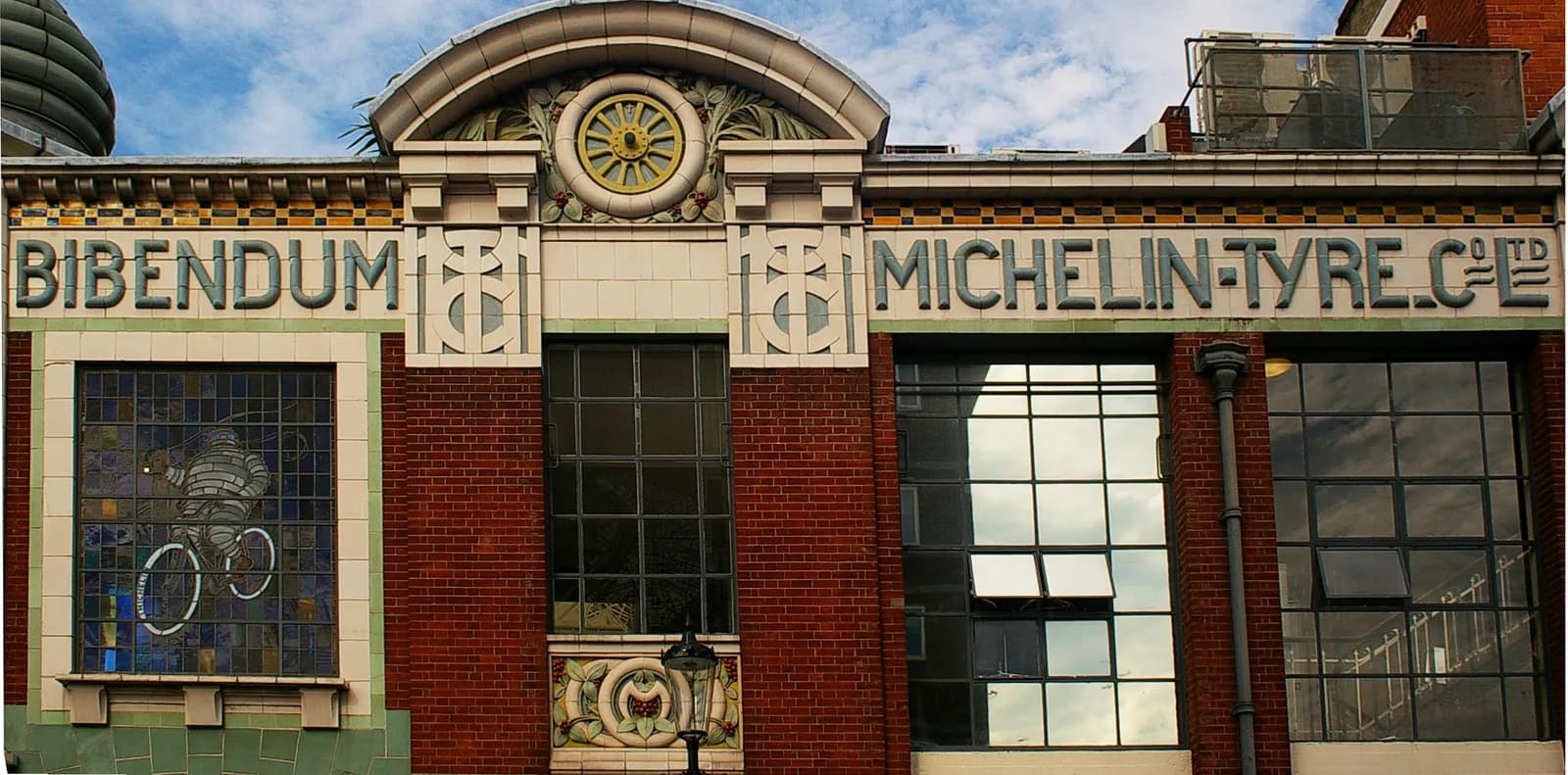
Standing at 81 Fulham Road, Michelin House has been a landmark since its opening on 20 January 1911. The building was designed by François Espinasse, a Michelin employee and engineer at the company's Clermont-Ferrand headquarters, making it the first permanent UK headquarters for the Michelin Tyre Company Limited.
A French Vision in Edwardian London
Michelin House is widely regarded as "the most completely French of any Edwardian building in London". It represents a unique architectural hybrid, bridging late Modern Style (British Art Nouveau) and early Art Deco influences. The building was constructed using the Hennebique ferro-concrete system, one of the earliest examples in Britain, which allowed for clear open spaces essential for tyre storage while providing crucial fire resistance.
The site was purchased in 1909 from the Cadogan and Hans Estate Company, bordered by Fulham Road, Sloane Avenue, Leader Street and Lucan Place. Final designs were completed by 4 April 1910, and remarkably, construction took only five months.
The Michelin Man Comes to Life
The origins of Bibendum, the Michelin Man, predate the building itself. The character was born in 1894 at the Lyon Exhibition, when Édouard Michelin noticed a stack of tyres that resembled a man without arms. The iconic poster design followed in 1898, created by French cartoonist Marius Rossillon (known as O'Galop), adapted from a rejected Munich brewery advertisement.
The name "Bibendum" derives from the Latin phrase "Nunc est bibendum" — "Now is the time to drink" — taken from Horace's Odes. The original poster depicted Bibendum offering a toast to scrawny competitors with a glass filled with nails and broken glass, implying that Michelin tyres could "drink up" road hazards. By 1908, the name was firmly established when Michelin commissioned writer Curnonsky to produce a newspaper column signed "Bibendum". Today, the Michelin Man remains one of the world's oldest trademarks still in active use, spanning more than 130 years.
Artistic Details and Architectural Features
The building's exterior features three large stained-glass windows depicting Bibendum, based on Michelin advertisements of the era. These are replicas; the originals were removed for safety during the Second World War and subsequently lost. The windows are complemented by decorative ceramic tiles at street level showing famous racing cars that used Michelin tyres.
Two distinctive glass cupolas at the front of the building resemble piles of tyres, also replicas of the originals. Inside, visitors find intricate tiles and mosaics, including a floor mosaic showing Bibendum holding aloft a glass containing nuts, bolts and hazards, again proclaiming "Nunc Est Bibendum". First-floor windows feature etchings of Paris streets, representing Michelin's association with road maps and tourism.
From Tyre Depot to Cultural Hub
When it opened, Michelin House included fitting bays, a Touring Office for maps and travel guidance, and basement storage capacity for 30,000 tyres. The floor was specially sloped to allow tyres to roll into position. Extensions followed in 1912 and 1922 as the business expanded.
The company moved its head office to Stoke-on-Trent in 1930, though it continued using the basement and ground floor of the Fulham Road building. The structure gained Grade II listed status on 15 April 1969, protecting its main facade facing Fulham Road.
Preservation and Rebirth
By the 1960s, the building faced potential demolition; outline planning permission was granted for a ten-storey office block. In 1985, Paul Hamlyn and Sir Terence Conran purchased Michelin House for £8 million. Following an extensive restoration costing £9 million, the building reopened in August 1987.
Today, the former tyre-fitting bays house the Bibendum Restaurant & Oyster Bar. The Sloane Avenue side accommodates The Conran Shop, housed in a glass and steel structure added during the 1986–87 redevelopment. Upper floors serve as office space, currently occupied by Argyll.
Fulham Road's Motoring Heritage
Michelin House stands as testament to Fulham Road's historical significance as "one of the main routes into London" and a prime destination for early motorists. The building predates other tyre company headquarters in Britain, including Fort Dunlop (1916) and the Firestone Building (1928). Its survival represents a triumph of preservation over demolition, securing a piece of Fulham's architectural heritage for future generations.